
Saint Elizabeth University Hosts Hesburgh Lecture on Mental Health, Faith, and Belonging
February 22, 2026
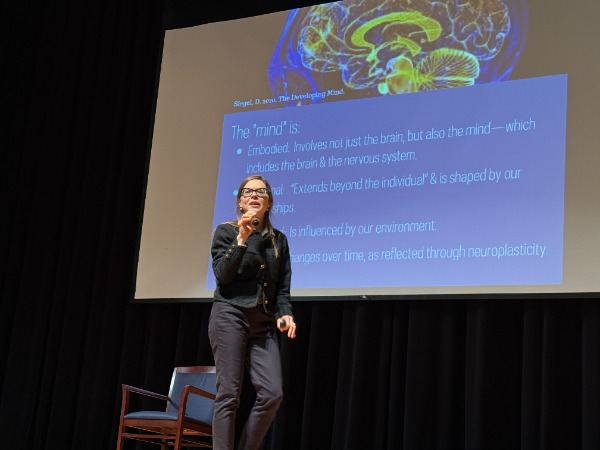
On Thursday, February 19, Saint Elizabeth University welcomed dozens of guests for a powerful and timely conversation on faith, mental health, and the human longing for belonging. The evening’s Hesburgh Lecture, titled “Mental Health, Hope, & Belonging,” was presented in collaboration with the Notre Dame Central Jersey Club and featured Beth Hlabse, Program Director of the Fiat Program on Faith and Mental Health at the University of Notre Dame’s McGrath Institute for Church Life.
Professor Hlabse, serving as the 2026 Hesburgh Lecture guest speaker, offered a thought-provoking reflection on the particular mental health challenges facing our society today. Introduced by Saint Elizabeth University Head of Mission Father Joseph Farias (ND ’85), the evening opened with prayer and a spirit of thoughtful engagement that carried throughout the program.
“We are incredibly proud to have partnered with the Notre Dame Central Jersey Club to bring such a notable and insightful speaker like Beth Hlabse to our campus,” said Andrea Adams, Director of Alumni and Annual Giving at Saint Elizabeth University. “Providing a space for these critical conversations on mental health and belonging is central to our mission, and seeing the community engage so deeply with these themes was truly inspiring.”
Faith and Reason: Two Wings of the Human Spirit
Drawing on the wisdom of Pope John Paul II, Professor Hlabse reminded attendees that “faith and reason are like two wings of the human spirit by which it soars to the truth.” Using this framework, she explored how science and spirituality work together, rather than in opposition, to address life’s most difficult questions.
Modern science, she noted, has made remarkable advances in helping us understand how we suffer. Clinical language, neuroscience, and psychological research provide essential tools to name and treat mental illness. Yet science alone cannot fully answer the deeper existential question: Why do I suffer? For that, Hlabse suggested, we must also turn to faith.
She challenged the audience to reconsider common assumptions about the mind itself, describing it not simply as a function of the brain but as something profoundly relationa: shaped by our connections with others. Mental health, she emphasized, is not a binary state. “We can experience flourishing with mental illness,” she explained, “and conversely, experience languishing without mental illness.”
Created for Relationship
Professor Hlabse also shared insights from a dinner conversation earlier that evening with Kevin J. Sweeney, Bishop of the Diocese of Paterson, and Psychology faculty member Dr. Christina Liparini, who met with the Notre Dame Central Jersey Club leadership prior to the event. Bishop Sweeney reflected on the theological truth that we are created in the image and likeness of God, who exists as a perfect relationship of Father, Son, and Holy Spirit.
If God is relational at His core, Hlabse explained, then to be relational is essential to who we are as human beings. Our need for connection is not weakness; it is woven into our identity.
From this foundation, she clarified the distinct role of friends, families, and communities in supporting those who struggle. “Our role is not to diagnose,” Hlabse told the audience. “Our role is to help each other have the courage to seek connection, belonging, and hope.” Rather than trying to fix someone’s pain, we are called to listen, accompany, and ensure that no one suffers alone.
A Call to Cultivate Belonging
The evening concluded with a practical and spiritual challenge: to intentionally cultivate “spaces for connection” within families, classrooms, parishes, and workplaces, especially during the Lenten season, a time marked by reflection and renewal. Attendees were encouraged both to seek belonging and to offer it, recognizing communion as a pathway toward healing.
Special thanks were extended to Andrea Adams and Father Joseph Farias for their instrumental roles in planning and launching the evening, as well as to Ed Caldwell (ND ’79) and Dwight Dachnowitz (ND P ’29) for leading the event on behalf of the Notre Dame Central Jersey Club. Their collaboration ensured a seamless and meaningful experience for all in attendance.
As guests departed, the message was clear: mental health conversations must extend beyond clinical categories to include faith, community, and the enduring human desire for hope. Through partnership and shared mission, Saint Elizabeth University and the Notre Dame Central Jersey Club created not just a lecture, but a space of genuine encounter and belonging.